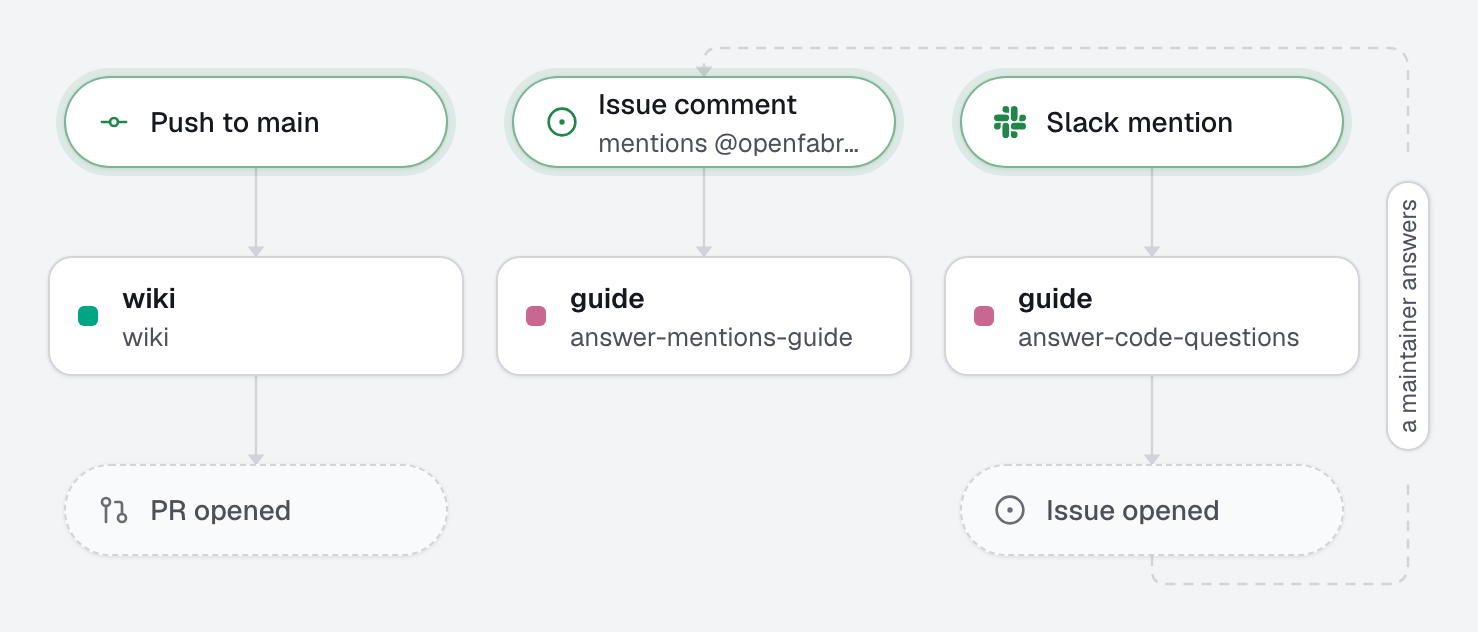
A guide to the code that lives in a Slack channel. Someone asks "where do we compute the VAT?" or "why does the export skip archived users?"; the factory reads the repository and answers in the thread, with the files and lines that prove it. When someone says "file this as a bug", it opens a GitHub issue and the engine posts the link in the thread. It never changes the code.
The concept: a read-only agent. It has the read tool and nothing else, and the automation lets the engine write only two things for it: a reply in the thread and a new issue.
What this factory does
The issue then enters your usual flow: combined with 02-sdlc, issue.opened starts triage.
Tree
openfabriq/
├── factory.yaml                       integrations.slack, low limits, wiki after each merge
├── agents/
│   └── guide/agent.md                 tools: [read]; answers from the code, never guesses
└── automations/
    └── answer-code-questions/         when: slack.mentioned; can: add_comment, create_issue
Least privilege
tools: [read]: the guide can read and search the checkout, nothing else. No shell, so it cannot run the code or reach the network. Addwebif you want it to read library documentation, knowing that a page it reads is one more source of text it must treat as data.can: [add_comment, create_issue]: from Slack,add_commentreplies in the thread.validaterefuses labels, pushes and reviews for a run that only comes from Slack.- Who can ask:
maintainersare GitHub logins and do not apply to Slack. Anyone in the channel can mention the factory, so anyone in it can read the code through it and spendusd_per_day. Use a private channel with the people who can already read the repository.
The wiki, after each merge
The guide answers faster when it starts from a map of the code than from a search of the whole repository. Every factory has that map, the wiki, written by an agent of the engine; here wiki: { refresh: after_merge } updates it after each merge on the default branch, instead of only when you ask. The first merge after start writes it, by pull request: merge it, and the guide reads its pages from then on. Each update is a run, within usd_per_run; remove the wiki key to update it only on demand.
Through your relay
Slack sends each mention to your relay: a Cloudflare Worker in your account (openfabriq connect relay, a free account is enough), or the same code on a machine of yours. Slack signs each event, the relay checks the signature and keeps the event up to 7 days, so a mention made at night is answered when the engine starts. The bot token stays on your machine to read the thread and reply.
Make it yours
- Copy the
openfabriq/folder to the root of your repository. - In
factory.yaml, replacerepository,maintainersand the Slackchannel. - Run
openfabriq connect relay, thenopenfabriq connect slack. It prints the Slack app manifest to paste, gives the signing secret to the relay, tests the bot token and keeps it in~/.openfabriq/secrets.json. - Invite the bot to the channel:
/invite @openfabriq. - Run
openfabriq plan,openfabriq apply, thenopenfabriq start. - Ask in the channel:
@openfabriq where do we send the welcome email?