15-security-audit is one agent that audits and reports. This is the heavier version, for a repository where a false alarm costs a day: one agent finds, another tries to prove it wrong, and only what survives becomes an issue. The finder is never the verifier, and the verifier runs on a stronger model. It changes nothing and exploits nothing.
The shape comes from Cloudflare's security-audit skill (MIT): isolated hunters per surface, a fresh verifier that tries to disprove each candidate, and a verdict that keeps "confirmed" apart from "cannot tell from the code". The skill itself needs sub-agents and an OS sandbox; here every role is an ordinary openfabriq agent and the roles are chained through GitHub.
What this factory does
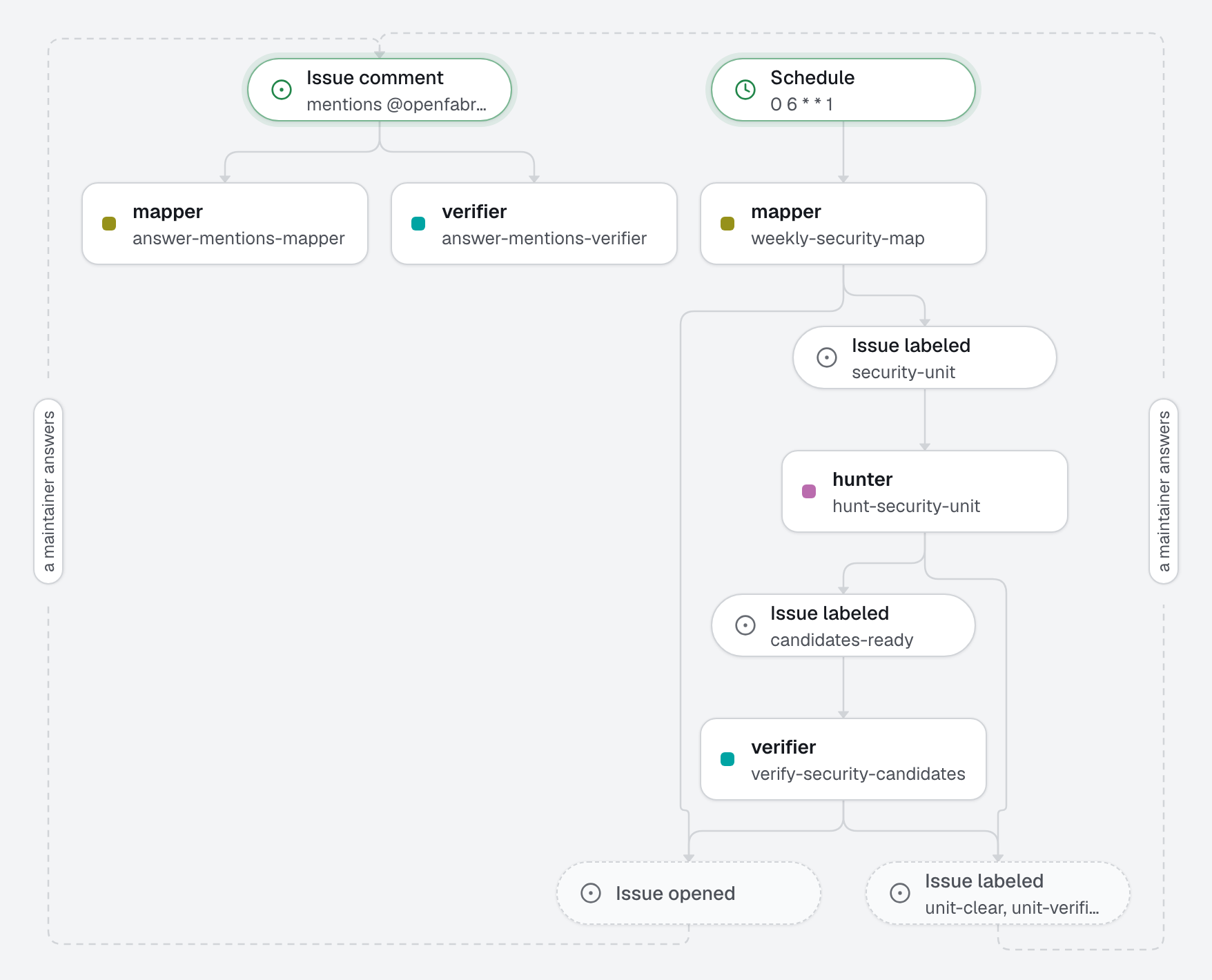
Three agents, three automations, no sub-agents: one unit issue is one hunter run, so the hunters work in parallel on their own, and each run keeps its own cost, time limit and transcript in the app.
Why it is more than 12
- A verifier that starts fresh. It gets the candidates, not the hunter's conviction, and its brief is to disprove them: find the validator, the permission check, the test that pins the safe behavior. A candidate it cannot disprove, and can retrace itself, is a finding.
- Three verdicts, not two. "Confirmed" has a retraced path and a stated impact. "Needs validation" names the single fact that lives outside the repository (a proxy, a cloud policy). "Rejected" says which control it found. Only "confirmed" gets a severity and an issue.
- A different place to look each week. The mapper ranks surfaces and skips those audited in the last 90 days that have not changed, so a week covers new ground instead of repeating the top five.
What a person keeps
Two small files in the repository, both read by the agents and written by you, in the same pull request as a fix or on their own:
security/known-findings.md: one fingerprint per line, with a word on why (filed as #42, accepted risk, false positive). Findings listed there are skipped. The agents cannot read GitHub, so this file is how last week's findings are remembered.security/audit-log.md: one line per unit,<slug> <date>, when a unit has been looked at. The unit issue says its slug. Without a line, the mapper picks the unit again next Monday.
Costs and limits
A week is one mapper, up to five hunters and up to five verifiers: eleven runs, the verifiers on the dearest model. limits.usd_per_day caps the day; raise or lower the five in the mapper's brief to fit your budget. Only units start a hunter: the engine puts the security-unit label on every issue the mapper opens (create_issue: [security-unit]), and the hunter listens to that label, so the finding issues the verifier opens start nothing.
Who sees the issues
Unit issues and the hunter's and verifier's comments are public on a public repository, and a candidate that was later rejected is still written down there. Run this factory on a private repository or a private fork. For a critical finding, use GitHub's private security advisories by hand.
Least privilege
No agent has edit. The mapper may only open unit issues, which the engine labels security-unit. The hunter may only comment, add candidates-ready or unit-clear, and close its unit when nothing holds. The verifier may only open finding issues, comment, add unit-verified, and close its unit. A unit with a needs-validation candidate stays open: the person who checks the missing fact closes it. Each is told never to exploit and never to copy a secret.
close_issue closes only the issue the run is about, never another one: a hunter or a verifier can only close its own unit. A closed issue reopens in one click. To hand a surface to a hunter yourself, open an issue like the mapper's and add the security-unit label.
Tree
openfabriq/
├── factory.yaml                          timezone, setup, the audit command, limits
├── agents/
│   ├── mapper/agent.md                   ranks the surfaces, opens the units
│   ├── hunter/agent.md                   finds candidates it can explain in one unit
│   └── verifier/agent.md                 tries to disprove them, on a stronger model
└── automations/
    ├── weekly-security-map/              when: schedule "0 6 * * 1"
    ├── hunt-security-unit/               when: issue.labeled security-unit
    └── verify-security-candidates/       when: issue.labeled candidates-ready
Make it yours
- Copy the
openfabriq/folder to the root of your repository. - In
factory.yaml, replacerepository,maintainers,timezone,setupand theauditcommand (npm audit --omit=dev --json,pip-audit -f json,bundle audit…), keeping the report in a file: the agent only gets the end of a command's output. - Add
audit-report.jsonto.gitignore, and createsecurity/known-findings.mdandsecurity/audit-log.md(both may start empty). - Run
openfabriq plan: it lists the labels it will create. Thenopenfabriq applyandopenfabriq start. - To try it without waiting for Monday:
openfabriq run weekly-security-map.
The engine writes with the gh account it runs under, and it trusts that account, so the issues and labels it writes start the next stage even when that account is not in maintainers.