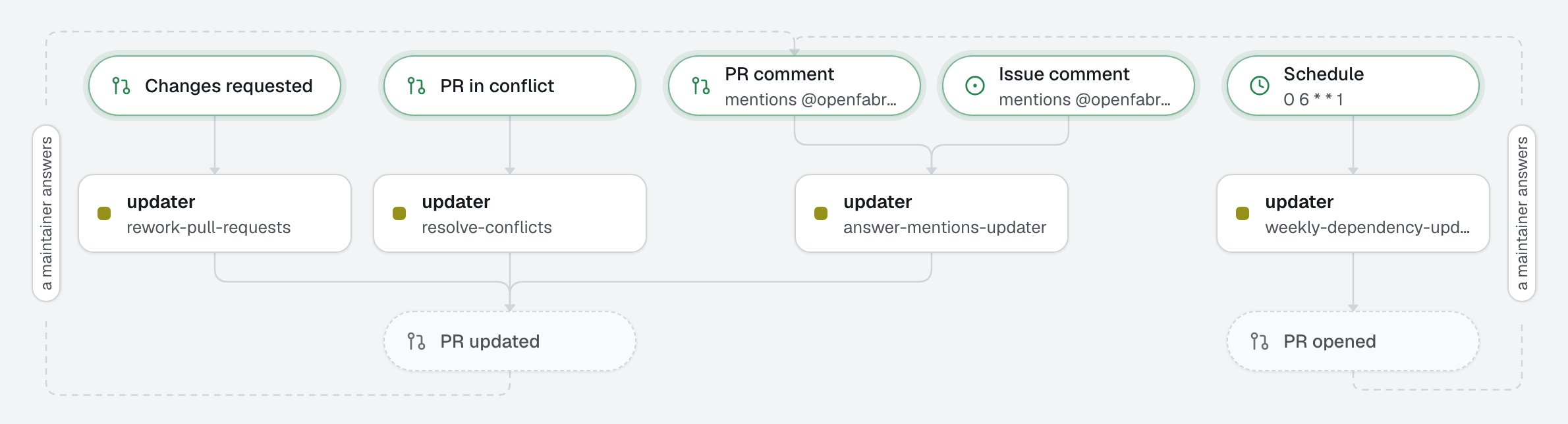
Dependency bots open one pull request per package and leave you to read the changelogs. Here, every Monday at 06:00, one agent bumps everything that is safe (minor and patch versions), runs the project's checks, and opens a single pull request with a table: package, from, to, what the changelog says, and the risk. Major versions are not touched; they are listed for a human, with their main breaking change.
What this factory does
Inside the run: outdated lists what is behind, the agent reads each changelog, edits package.json, runs install to update the lockfile, then test, lint, typecheck and build. A bump that breaks a check is reverted and listed as skipped. Before the pull request leaves the machine, the engine runs the checks itself and refuses it if one fails.
Notes
scheduleruns in the factory'stimezone. If the machine sleeps at 06:00, the run is caught up once, at the next wake-up.concurrency: repository: one run at a time for the whole repository, so a slow week never ends with two update runs racing on the same lockfile.setup,commands,checks: the agent has noshell. It runs the named commands offactory.yamland nothing else. They run in the engine's sandbox, where the package manager's cache is writable; an agent's own shell cannot install packages. Without git, it commitspackage.jsonand the lockfile through the engine'scommittool.outdatedends in failure when something is behind (npm outdatedandpnpm outdatedexit with code 1): the agent reads its output all the same.weblets the agent read changelogs and release notes. What it reads there is data, not instructions.- The agent cannot see GitHub: it does not know whether last week's pull request is still open. Merge or close it before the next Monday, or you get two.
Tree
openfabriq/
├── factory.yaml                               timezone, setup, commands (outdated, install, test…), checks
├── agents/
│   └── updater/agent.md                       safe bumps, a table per package, majors for a human
└── automations/
    ├── weekly-dependency-updates/             when: schedule "0 6 * * 1", concurrency: repository
    ├── rework-pull-requests/                  when: pull_request.changes_requested
    └── resolve-conflicts/                     when: pull_request.conflicted (lockfile regenerated, never edited)
Make it yours
- Copy the
openfabriq/folder to the root of your repository. - In
factory.yaml, replacerepository,maintainersandtimezone, and adaptsetupandcommandsto your package manager (npm outdatedandnpm install, for example). - Change the
cronif Monday 06:00 does not suit you. To have it run on time, wake the machine just before:sudo pmset repeat wakeorpoweron M 05:55:00on macOS. - Run
openfabriq plan: it lists the commands and checks as security changes, since they run on your machine. openfabriq apply, thenopenfabriq start.- To try it now rather than on Monday:
openfabriq run weekly-dependency-updates.